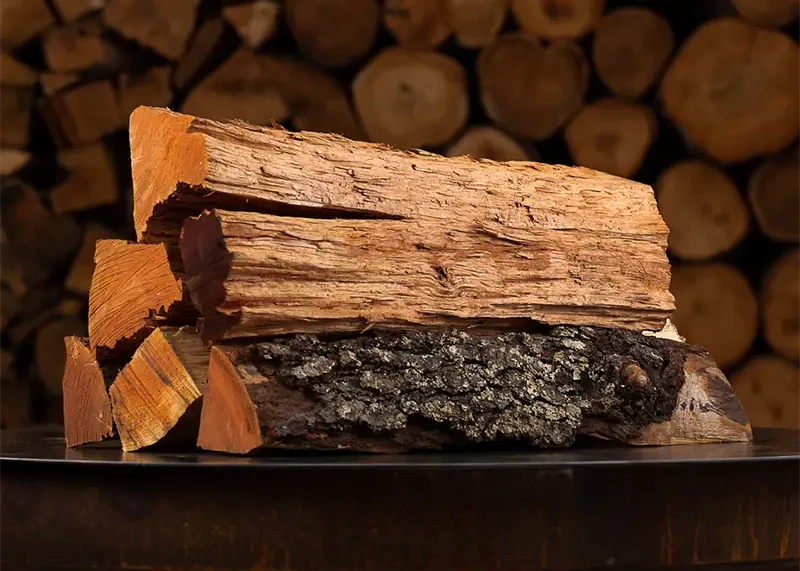
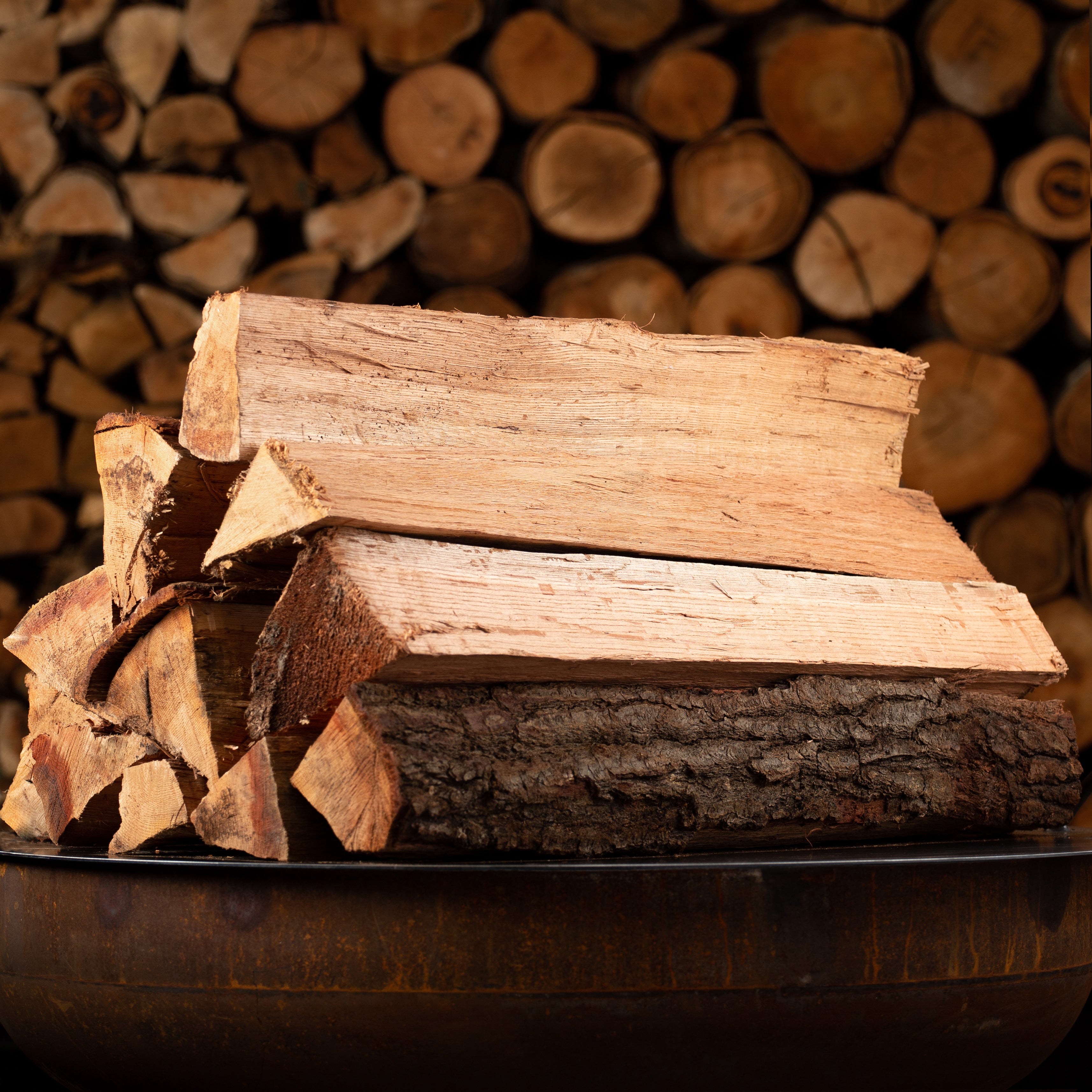
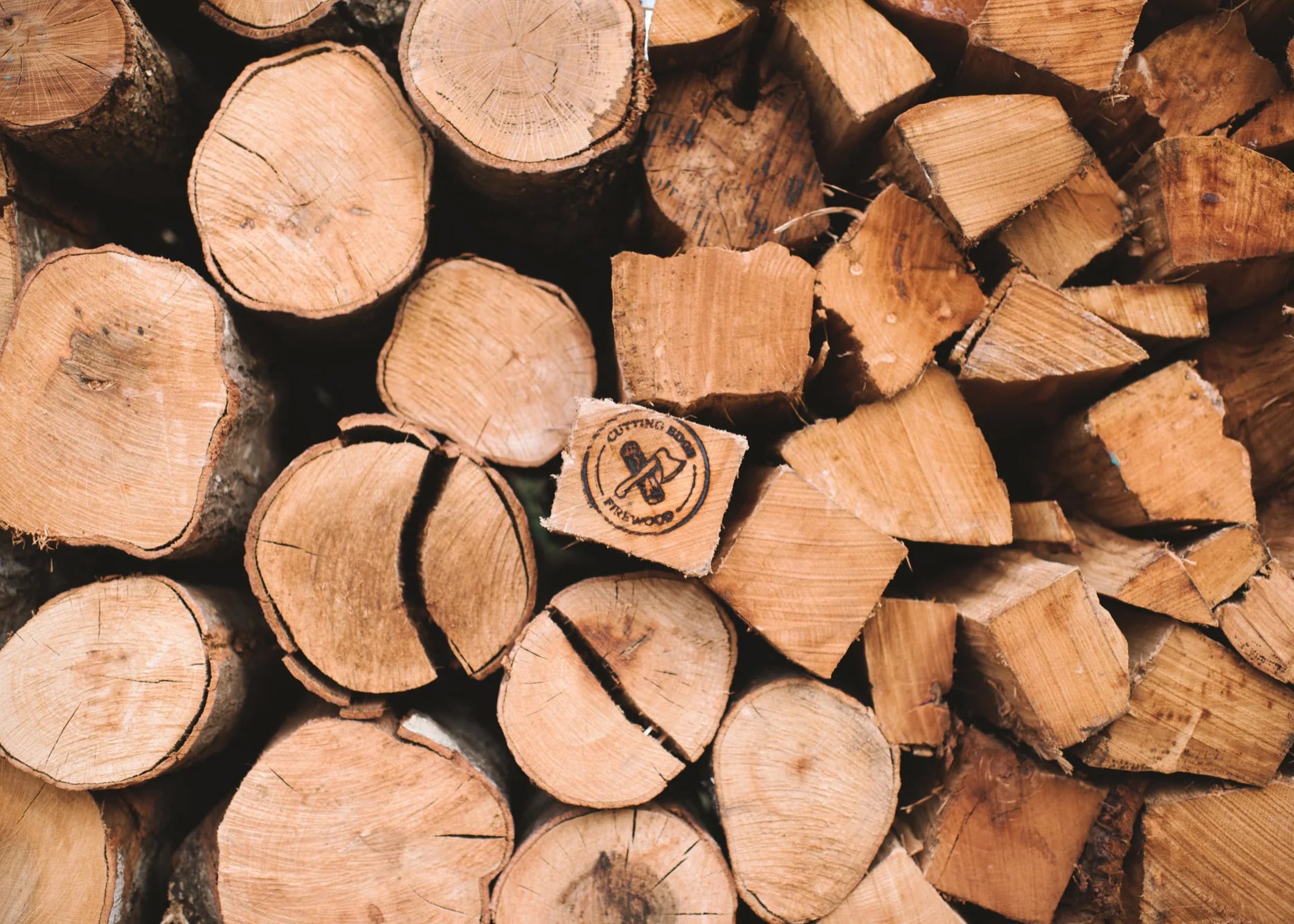

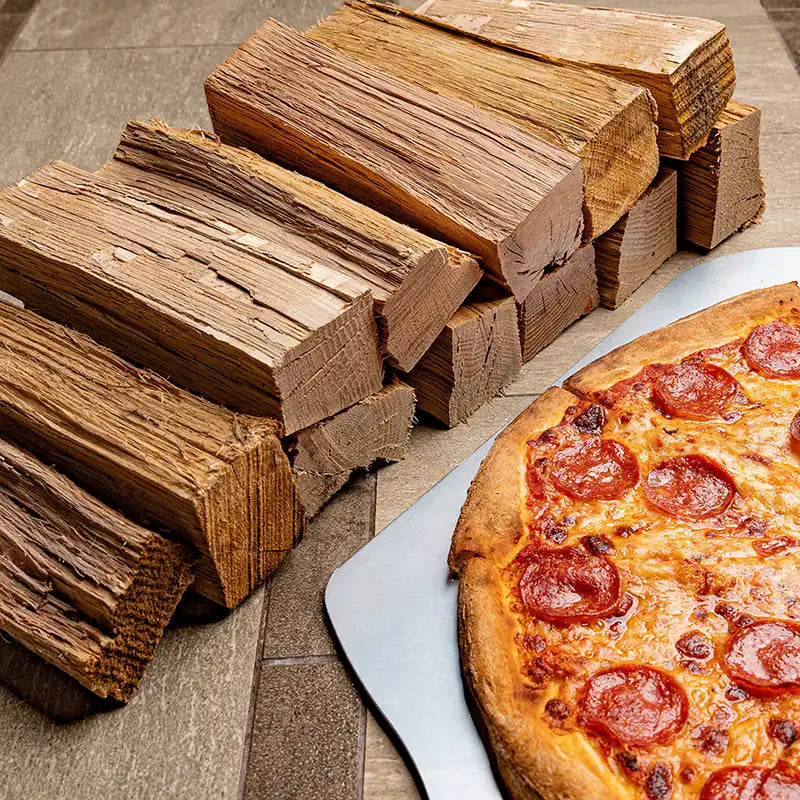

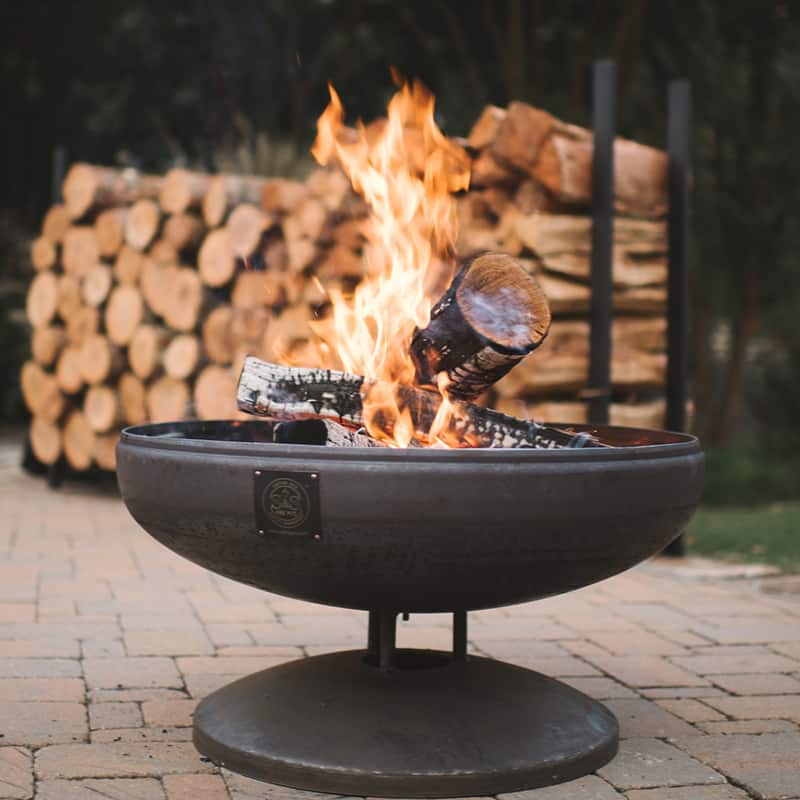

Seasoned firewood is wood that has been cut, split, and left outside to air-dry for at least 12 months until its moisture content drops below 20%. The seasoning process evaporates the natural moisture stored in the wood's cells and sap so it burns more efficiently than freshly cut "green" wood.
If you're shopping for firewood for your fireplace, fire pit, or wood stove, "seasoned" is one of the first words you'll encounter — and one of the most loosely used. In theory, seasoned firewood is dry, ready-to-burn wood. In practice, it's a wildcard. The same word covers wood that's been carefully air-dried for two years and wood that was cut three months ago and left under a tarp.
This guide breaks down exactly what seasoned firewood means, how to tell if your wood is genuinely seasoned, how it stacks up against kiln-dried firewood (a far more consistent option), and what to look for if you want predictable, smoke-free fires.

What Is Seasoned Firewood?
Seasoned firewood is firewood that has been left outdoors — typically stacked, covered on top, and open to airflow on the sides — long enough for the natural moisture inside the wood to evaporate. Freshly cut wood (called green firewood) contains roughly 50% water by weight. The goal of seasoning is to get that number down to 20% or less, which is the threshold most chimney sweeps and firewood retailers use to define "ready to burn."
That sounds simple, but it isn't. Wood doesn't dry on a predictable schedule — it depends on the species, the size of the splits, the climate, the airflow around the stack, and the weather. Hardwoods like oak can take 18–24 months to fully season. Softer woods like pine can be ready in 6–9 months. And wood left in a damp pile, on the ground, or under a fully wrapped tarp may never season properly because air can't move through the stack.
It's also worth distinguishing seasoned firewood from kiln-dried firewood. Kiln-dried wood is rapidly dried in a controlled-temperature chamber — typically reaching well under 15% moisture in 48–72 hours, with mold, bugs, and fungi sterilized by the heat. The end product is more consistent, lighter, and cleaner-burning than even a perfectly seasoned cord. We'll cover that comparison in detail below.
How Long Does It Take to Season Firewood?
For most hardwoods, plan on 12 to 24 months of seasoning before the wood is genuinely ready to burn. Softer species like pine, fir, and cedar can be ready in 6 to 12 months. The exact timeline depends on five factors:
- Species. Oak takes the longest — 18–24 months is realistic. Cherry, hickory, and maple need 12–18 months. Birch, ash, and pine season faster.
- Split size. Smaller splits dry faster than full rounds. Wood split to fireplace-ready dimensions seasons in roughly half the time of unsplit logs.
- Stacking. Off the ground, with airflow on at least three sides, is essential. Wood piled in heaps almost never seasons evenly — the center stays wet for years.
- Climate. Hot dry summers accelerate drying. Cool damp climates slow it down dramatically. The Pacific Northwest will season slower than Arizona.
- Weather protection. A roof or tarp on top (but open sides) keeps rain off without trapping moisture.
The rule of thumb in the firewood industry: cut, split, and stack one full year ahead of when you intend to burn it. Two years ahead for oak.
How Do You Know If Firewood Is Seasoned?
The most reliable way to confirm whether firewood is seasoned is to use a digital moisture meter. Push the two metal pin probes into the cut end-grain face of a freshly split piece (not the bark side, not the smooth surface — the freshly exposed inside). A reading of 20% or less means the wood is seasoned and ready to burn. A reading above 25% means the wood is still wet and will smoke heavily, light poorly, and produce excess creosote.

If you don't have a moisture meter, there are visual and physical cues that suggest seasoned wood:
- Color: Seasoned wood is darker and grayer than fresh-cut green wood. The ends often look weathered.
- End-grain checking: Look for radial cracks running from the center of the cut face outward. Checking is a reliable indicator that the wood has dried significantly.
- Weight: Seasoned wood is noticeably lighter than green wood — moisture is heavy. A piece that surprises you with how light it feels is likely seasoned.
- Sound: Knock two pieces together. Seasoned wood rings with a hollow, hard knock. Wet wood thuds dully.
- Bark: Bark on seasoned wood comes loose easily and often falls off when handled.
What seasoning doesn't tell you: whether the wood was kept clean. Air-dried firewood is a magnet for bugs, mold, and fungus. According to Purdue University Extension, even properly seasoned firewood stored outdoors typically attracts carpenter ants, termites, beetles, and various wood-boring insects — none of which you want to bring inside your home. Seasoning solves the moisture problem, but creates several others.
Seasoned vs Kiln-Dried Firewood: Comparison Table
The single most important difference is the drying method — and that one difference cascades into nearly every measurable variable that affects how the wood burns.
| Variable | Seasoned Firewood | Kiln-Dried Firewood |
|---|---|---|
| Moisture content | 15–25% (highly variable) | 5–15% (consistent) |
| Drying time | 12–24+ months | 48–72 hours |
| Burn time per log | Shorter (some energy lost to evaporating residual moisture) | Longer (denser, all energy goes to heat) |
| Smoke output | Moderate to heavy, sometimes acrid | Minimal, clean |
| Heat output (BTUs) | Reduced — wet wood wastes energy boiling off water | Maximum — all energy converts to heat |
| Creosote production | Higher — wet smoke condenses in the chimney | Minimal — hot, clean burn limits residue |
| Bugs & mold risk | High — open-air storage attracts pests and fungi | Eliminated — kiln heat sterilizes the wood |
| Indoor storage friendly | Risky — pests can spread to your home | Yes — clean, dry, pest-free |
| Consistency | Highly variable — depends on supplier and storage | Highly consistent — controlled process |
| Cost | Lower per cord | Higher per cord, lower per BTU delivered |
For a deeper read on why air-drying creates problems that no amount of patience can solve, see our companion piece: what is seasoned wood and why you don't want to use it.
Why Seasoned Firewood Is So Inconsistent
If you've ever bought firewood from two different suppliers and gotten wildly different burning experiences, the reason is almost always inconsistency in how the wood was seasoned. The "seasoned" label has no legal definition and no industry quality standard. A reputable supplier who cuts, splits, and stacks wood properly for 18 months will deliver something close to 20% moisture. A less scrupulous supplier might cut a tree last month, leave it in a heap, and call it "seasoned" because someone told them six months is enough.
Even with a careful supplier, weather conditions during the seasoning year can shift the outcome by 5–10 percentage points. A wet summer means slower drying. Wood stored against a fence rather than in the open dries unevenly. Stacks that get rained on regularly without a roof can actually regain moisture from precipitation faster than they lose it through evaporation.
The result is the experience most homeowners report: one delivery burns clean and hot, the next smokes heavily and won't stay lit. That inconsistency is the seasoned firewood market in a sentence.
The Downsides of Using Seasoned Firewood
Even if your seasoned firewood is genuinely 20% moisture or less, several disadvantages remain compared to kiln-dried alternatives:
- Harder to light. Seasoned firewood retains 4–5× more moisture than kiln-dried wood. Even properly dried air-cured wood requires more kindling and patience to ignite cleanly.
- Worse aroma. Higher residual moisture means a mustier, less pleasant smoke profile. Mold contamination during seasoning — extremely common — produces smoke that smells acrid and sticks to clothing and upholstery.
- More emissions. Wet wood burns at a lower temperature and incomplete combustion releases more particulates and unburned hydrocarbons into the air. Wet-wood smoke is a documented contributor to neighborhood air-quality problems in wood-burning seasons.
- Bugs, mold, and fungus. Open-air seasoning attracts pests. Storing seasoned wood inside your home is how termite, beetle, and ant colonies get introduced into walls and structural lumber.
- Active decomposition. Seasoning is essentially controlled rot. The wood's cellular structure breaks down over 12–24 months, which means it becomes less dense — and lower-density wood burns faster, putting out fewer total BTUs per log.
- More creosote. Residual moisture vaporizes as the wood burns, condenses on cooler chimney walls, and forms creosote — a documented chimney fire hazard. Drier wood means cleaner flue.
Why Kiln-Drying Is Different
Kiln-dried firewood is fresh-cut wood placed in a heated, controlled-airflow chamber. The USDA's minimum standard for kiln-dried firewood is 160°F core temperature for at least 75 minutes — enough to kill bugs and most fungi. Premium operations go much further. Cutting Edge Firewood ultra kiln-dries at 250°F for 48 hours, which drives moisture content well below 15% and sterilizes the wood completely.
The result is wood that's dense (the kiln preserves the wood's full energy content because it's dried before significant decomposition begins), bright (no weathered grey surface), light (low moisture means low weight), and clean (no pests, no mold, no fungal spores). For the same volume of firewood, you get more heat, longer burn times, less smoke, less creosote, and you can store it indoors next to your fireplace without worrying about what's hitching a ride.
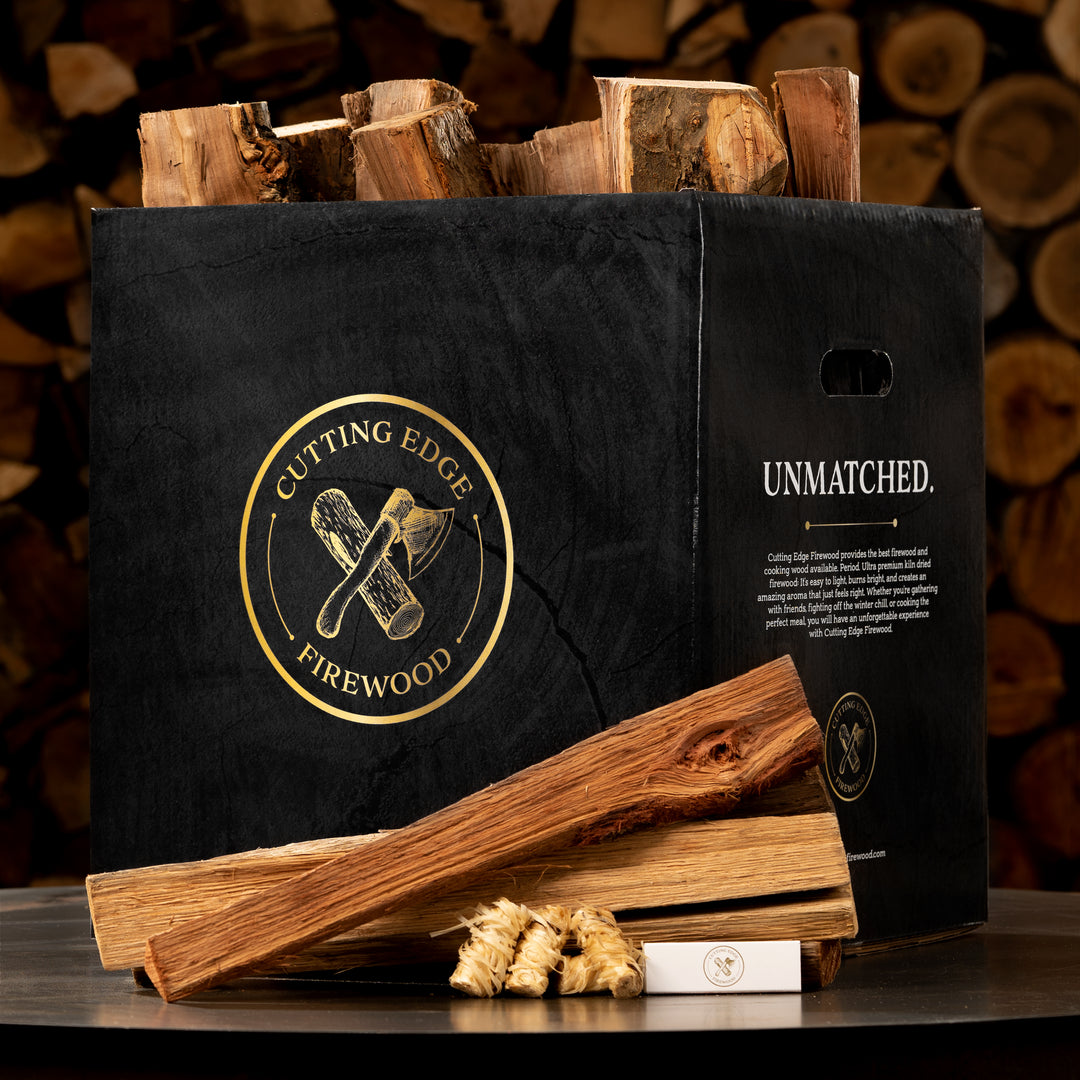
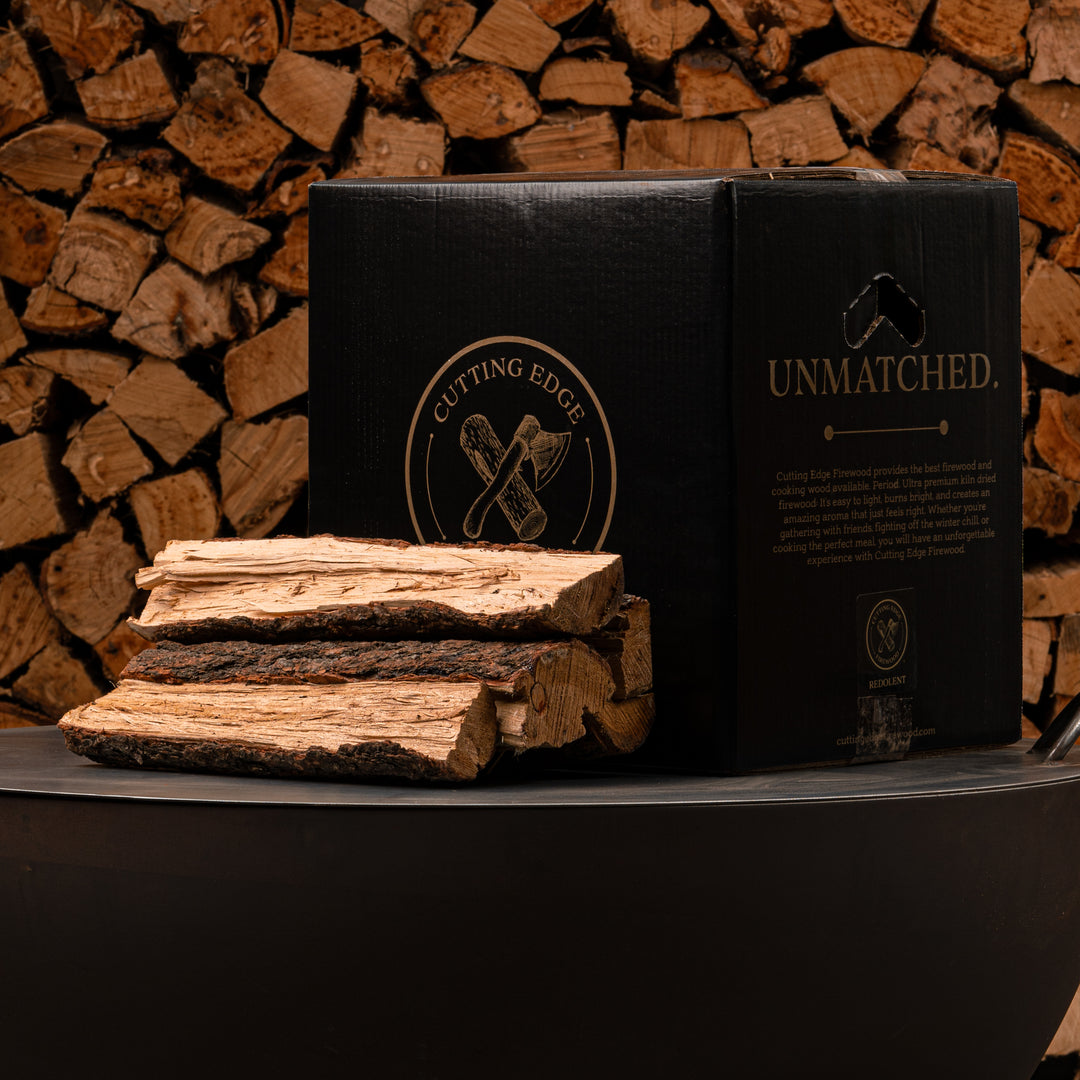
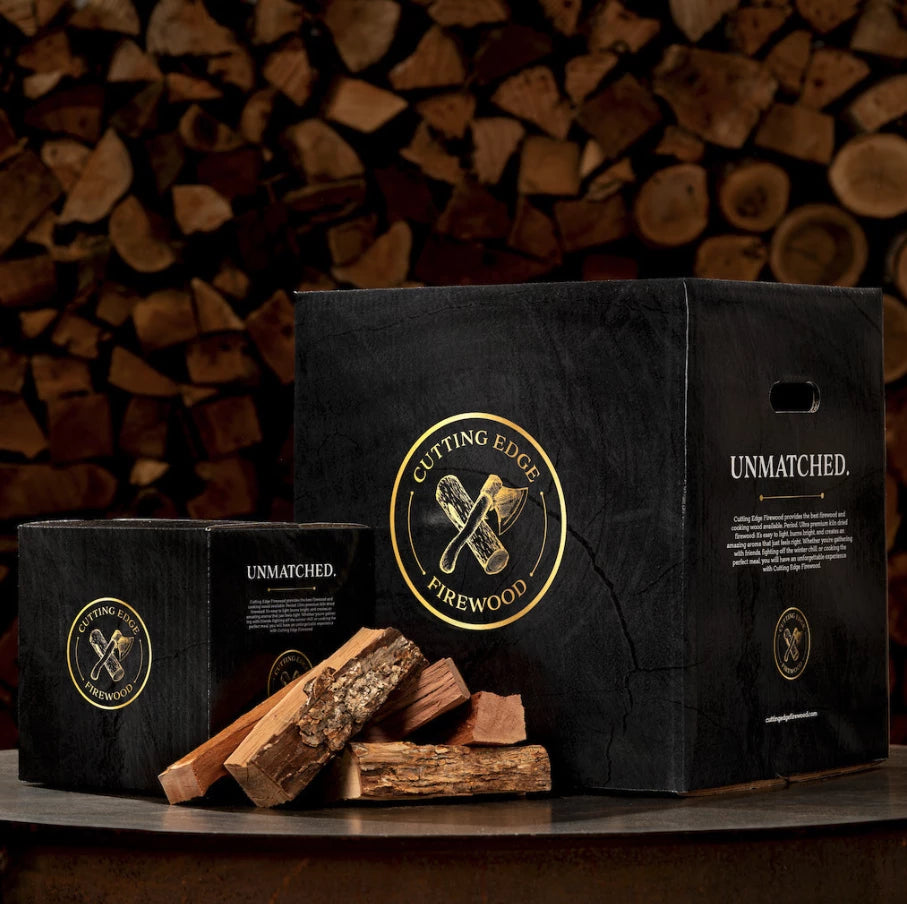
For high-volume buyers, our oak firewood box delivers a curated quantity of premium kiln-dried oak — split, stacked, and shipped ready to burn.
How to Store Kiln-Dried Firewood
Because kiln-dried firewood arrives at extremely low moisture content, your only job is to keep it that way. Three rules:
- Off the ground. Direct ground contact draws moisture into the bottom row of any stack. A pallet, rack, or even bricks beneath the wood prevents this.
- Top covered, sides open. A roof or tarp over the top keeps rain off; open sides let any residual moisture escape. Fully wrapping a stack creates a moisture trap.
- Indoors is fine — for kiln-dried only. Because kiln-drying eliminates pests, fungi, and mold, kiln-dried firewood is safe to store inside (in a basement, garage, or alongside the fireplace). Air-dried wood should never come indoors for the same reason.
Our firewood racks are designed for exactly this — elevated, ventilated, weather-resistant storage that preserves kiln-dried wood at peak burning quality indefinitely.
The Bottom Line: Seasoned vs Kiln-Dried
Seasoned firewood is the traditional answer to drying wood. It's cheaper per cord, widely available, and adequate for fires when you've genuinely got an 18–24 month supply chain and disciplined storage. But it comes with real and measurable trade-offs: variable moisture, pest contamination, mold risk, more smoke, more creosote, and unpredictable performance from one delivery to the next.
Kiln-dried firewood solves every one of those problems through process control. The wood is drier, lighter, cleaner, denser, and pest-free — and because moisture content is documented and consistent, every fire burns the same way. For most homeowners who burn fires for ambiance, heat, or cooking, the question isn't whether kiln-dried is better. It's whether the predictable, premium experience is worth the upfront cost. For most, it clearly is.
If you've been frustrated by inconsistent fires, smoky rooms, hard-to-light logs, or the surprise of finding bugs in your indoor firewood pile — that's the seasoned-wood experience. Kiln-dried is what fixes it.
Seasoned Firewood FAQ
How long does it take to season firewood?
Most hardwood firewood needs 12 to 24 months of air-drying to season properly, with oak typically requiring the full 18–24 months and softer hardwoods like cherry, maple, and birch ready in 12–18 months. Softwoods such as pine, fir, and cedar can season in 6–12 months. The wood must be cut, split to burning size, and stacked off the ground with airflow on at least three sides. Stacks left in heaps or against fences season unevenly and may never reach the 20% moisture threshold needed for clean burning.
Is seasoned wood the same as dry wood?
Not necessarily. "Seasoned" describes the process of air-drying, not a guaranteed moisture level. Wood is considered seasoned when its moisture content drops below 20%, but the same word is used loosely in the firewood market to describe wood that hasn't actually reached that threshold. Truly dry wood — under 15% moisture — usually requires kiln-drying, because air-drying rarely brings wood below 18–20% even after 24 months. The only way to confirm dryness is with a moisture meter on the freshly split end-grain.
Seasoned vs kiln-dried firewood: which is better?
Kiln-dried is better on nearly every measurable variable: lower moisture (5–15% vs 15–25%), more consistent burn, less smoke, less creosote, no bugs or mold, and indoor-storage safe. Seasoned firewood is cheaper per cord and adequate when properly cut, split, and stored for 18+ months — but quality varies wildly between suppliers. Kiln-drying eliminates that variability through process control. For predictable, clean-burning fires, kiln-dried wins. For low-cost casual fires where occasional smoke and inconsistency are acceptable, seasoned can work.
How do you know if firewood is seasoned?
The most reliable test is a digital moisture meter — push the pin probes into a freshly split end-grain face and look for a reading of 20% or less. Without a meter, look for visual and physical cues: gray-brown weathered color, radial cracks (checking) on the cut ends, noticeably lighter weight than fresh-cut wood, a hollow ringing sound when two pieces are knocked together, and bark that comes loose easily. None of these are as definitive as a moisture-meter reading, but together they suggest the wood has air-dried for a meaningful length of time.
The Bottom Line
Seasoned firewood means air-dried firewood that has spent at least a year losing its natural moisture — but the term carries no quality guarantee. Inconsistent suppliers, variable storage, and unavoidable bugs and mold during the seasoning process make it a coin flip whether the wood you buy will actually burn well. Kiln-dried firewood solves these problems through controlled drying that's faster, cleaner, denser, and sterilized — making it the more reliable choice for anyone who values consistent performance, indoor storage, and clean fires.