


Buy firewood for the first time and you'll quickly hit a wall of conflicting terminology — cord, half cord, face cord, rick, rank, rack, truckload. Some of those words mean the same thing. Some mean very different things. And one of them is the only firewood measurement that's actually legally defined in the United States.
Getting this right matters because firewood is one of the few products still sold by volume rather than weight, and unscrupulous sellers exploit the confusion. A "rick" delivered in one county can be a third the wood of a "rick" delivered in the next county over, even at the same price. This guide breaks down every common firewood measurement, shows you exactly how the volumes compare, and tells you what to ask before you pay.
The Quick Answer
A cord is the only standardized firewood measurement: 128 cubic feet, stacked 4 feet wide × 4 feet deep × 8 feet long. A rick is the same as a face cord — a single row 4 feet tall × 8 feet long, with depth equal to the log length (typically 16"). A rick equals roughly one-third of a full cord. "Rick," "rank," and "rack" are regional synonyms for face cord; none are legally defined.
What Is a Cord of Wood?
A cord of wood is the U.S. legal standard for selling firewood, defined by the National Institute of Standards and Technology (NIST) Handbook 130 as a stack of wood measuring 4 feet wide by 4 feet high by 8 feet long — exactly 128 cubic feet of wood, bark, and air. Most U.S. states adopt this definition by statute, which means selling firewood by any other unit (rick, face cord, truckload) without disclosing the cord-equivalent volume is technically a weights-and-measures violation.
The term comes from 17th-century lumberjacks who used cords of rope to bundle and secure standardized stacks for transport. The dimensions stuck because they're practical: a 4-foot stack is shoulder-high, an 8-foot length fits common pickup beds and trailers, and 4 feet of depth approximates two full log lengths stacked back-to-back.
A typical full cord contains roughly 550–650 individual splits, depending on log diameter and how tightly the stack is built. For context: a single full cord can heat an average, well-insulated home using a wood stove for roughly six to eight weeks of full-time winter burning.
What Is a Rick or Face Cord?
A rick — also called a face cord — has the same height and width as a full cord (4 feet × 8 feet) but is only one row deep. The depth of that single row equals the length of the individual logs, which is usually 16 inches in the U.S. but can range from 12 to 24 inches depending on the seller and the firebox the wood is cut for.
That depth difference is everything. A face cord of 16-inch logs is roughly 42.7 cubic feet — exactly one-third of a full cord. A face cord of 24-inch logs is 64 cubic feet — half a cord. So when a seller quotes you "a rick" or "a face cord," the first question to ask is: how long are the logs?
Reddit's r/firewood community sums it up bluntly: a face cord "is not an official measurement, but it is exactly 1/3 of a full cord, being a single row of 16" length wood, that is 4' tall and 8' long." The same logic applies to "rick," which most regional sellers use interchangeably with face cord.
Visual Stacking Comparison
Each measurement below is shown as a top-down footprint, with all four sharing the same 4-foot height and 8-foot length. The variable is depth — the dimension that drives the volume.

Firewood Measurement Comparison Table
| Measurement | Dimensions (H × D × W) | Volume | % of Full Cord | Approx. Splits | Burn Time (avg. wood stove) |
|---|---|---|---|---|---|
| Full Cord (legal standard) | 4' × 4' × 8' | 128 cu ft | 100% | 550–650 | 6–8 weeks of full-time winter burning |
| Half Cord | 4' × 2' × 8' | 64 cu ft | 50% | 275–325 | 3–4 weeks |
| Face Cord / Rick / Rank (16" logs) | 4' × 16" × 8' | ≈ 43 cu ft | ~33% | 180–220 | ~2 weeks |
| Quarter Cord | 4' × 1' × 8' | 32 cu ft | 25% | 140–165 | ~10 days |
| Truckload (half-ton pickup, level bed) | varies | ≈ 32–48 cu ft | 25–38% | ~150–250 | ~2 weeks |
Two important caveats. First, the rick/face cord row assumes 16" logs — a common but not universal length. With 24" logs, a face cord becomes a half cord. Second, "truckload" is the least standardized of all and varies wildly between trucks and how the wood is loaded (heaped vs. level).
Why Is It Called a "Rick"? Origin and Regional Names
The word rick dates back to Old English hrēac, originally meaning a stack of hay or grain. By the 19th century it had broadened to mean any orderly outdoor stack, including firewood. Sellers gradually adopted "rick" as a marketing-friendly alternative to "face cord" because customers kept assuming a face cord and a full cord were the same thing — the word "cord" in face cord did most of the misleading work.
Regional synonyms you'll still encounter:
- Rank — common in parts of the Upper Midwest and Appalachia
- Rack — used in some Southern states
- Run — occasional usage in the Pacific Northwest
- Stove cord — older New England term, typically for shorter (12") logs
None of these have legal definitions, which is exactly why NIST Handbook 130 recommends always selling firewood by the cord, half cord, or quarter cord — units defined by volume, not stacking style.
How Many Ricks Make a Cord?
For 16-inch logs (the most common U.S. length), three ricks equal one full cord. The math: a full cord is 4' deep, and a single rick is 16" (1.33') deep. 4 ÷ 1.33 = 3 rows. Stack three face cords back-to-back-to-back and you've built a full cord.
The ratio changes with log length:
- 12" logs: 4 ricks per cord
- 16" logs: 3 ricks per cord (most common)
- 20" logs: 2.4 ricks per cord
- 24" logs: 2 ricks per cord (at this length, a "rick" is functionally a half cord)
This is why pinning down log length in the seller's quote is non-negotiable. The same word, "rick," can mean 32 cu ft or 64 cu ft depending on cut.
How Much Firewood Do You Actually Need?
Match the volume to the use case so you don't overpay or under-buy:
- Occasional ambiance fires (1–2 per week, fireplace): A face cord or rick is plenty for a full season.
- Weekend cabin or guest house: Half cord covers most weekends from October through March.
- Primary heat source (wood stove, well-insulated 1,500 sq ft home): Plan on 3–5 full cords per winter, depending on climate.
- Pizza oven or outdoor cooking only: A quarter cord or two boxes of cooking wood per season is typical.
- Fire pit / outdoor entertaining: A face cord lasts the average household one summer of regular use.
For seasoned firewood to be ready when you need it, plan to buy 6–12 months ahead and store it correctly. Our kiln-dried firewood racks keep the stack elevated and aerated so the wood stays at optimal moisture content rather than reabsorbing humidity from the ground.
Pricing: Why Bulk Cords Cost Less Per Cubic Foot
Firewood pricing follows the same logic as most bulk goods: the smaller the unit, the higher the cost per cubic foot. A full cord typically prices between $300 and $700 depending on species, region, and whether the wood is seasoned, kiln-dried, or green. A face cord generally runs $120–$280 — but on a per-cubic-foot basis, you're often paying 15–30% more than buying the equivalent cord volume.
Three factors drive the markup on smaller measurements:
- Delivery overhead. A truck rolling out for one face cord costs the supplier nearly the same as a truck rolling out for a full cord.
- Splitting and stacking labor. Smaller bundles are more handling per cubic foot.
- Seller margin. Face cord buyers tend to be casual users with less price sensitivity than serious wood-heat customers.
If you're going to burn through more than two ricks in a season, the per-cubic-foot economics almost always favor buying a full cord and storing the surplus.
How to Avoid Getting Cheated on Firewood
Because face cord, rick, rack, and truckload have no legal definition, mismeasured deliveries are common. Protect yourself with these checks (and see our full guide to ordering firewood for a complete buyer's walkthrough):
- Get the dimensions in writing. Before paying, get the seller to confirm the height, depth, and width of the stack you're buying. If they refuse, walk away.
- Measure the delivered stack yourself. Stack it tight — wood, bark, and air, with gaps small enough that "a chipmunk could run through but not a cat," as the traditional rule goes — then multiply length × height × depth in feet. Compare to what was quoted.
- Demand cord-equivalent on the receipt. Most U.S. states require firewood receipts to state the volume in cords or fractions of a cord. If the receipt only says "1 rick" or "1 truckload," request a corrected receipt.
- Confirm species and seasoning. Volume alone isn't the full picture — green oak weighs more but burns far less efficiently than seasoned oak. Always ask about seasoning or kiln-drying.
- Beware the heaped truckload. A pickup bed heaped with logs looks impressive but typically holds only 30–50% of a full cord once stacked properly.
The Cutting Edge Firewood Approach: Standardized Boxes
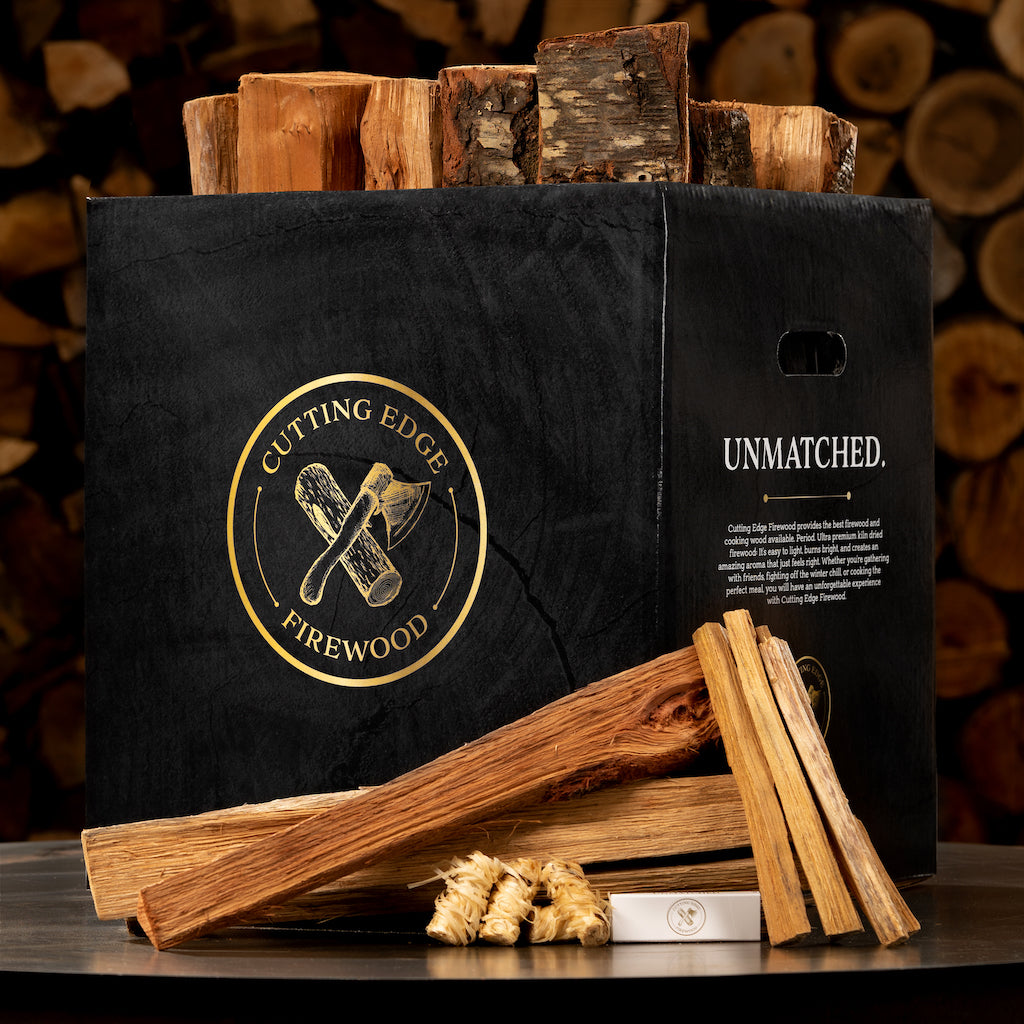
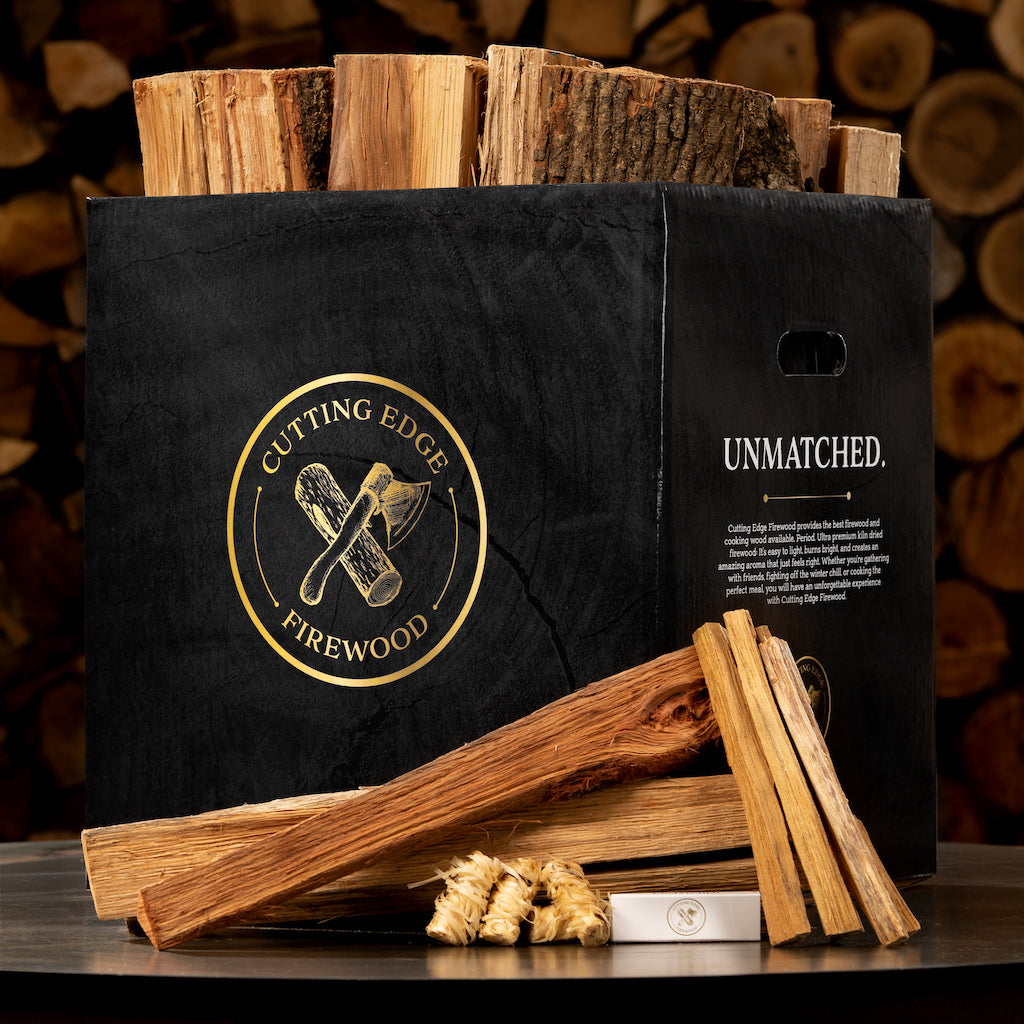
At Cutting Edge Firewood, we sidestep the cord/rick/face-cord ambiguity entirely. Every order is delivered in standardized boxes and bundles with disclosed cubic-foot volume, kiln-dried to under 20% moisture, and species-labeled (oak, hickory, cherry, etc.). You know exactly what you're paying for, exactly how it will burn, and exactly how much space it will take in your storage area.
For long-burn winter heating we recommend our ultra kiln-dried firewood, dried to a fraction of the moisture content of seasoned wood for a hotter, cleaner burn. For pizza ovens and outdoor cooking, our cooking wood is sized and species-matched to specific heat profiles. For a complete fire-building setup, our fire starters collection pairs cleanly with whichever volume of wood fits your usage.
Frequently Asked Questions
Is a cord of wood the same as a rick?
No. A cord and a rick are different firewood measurements. A full cord is the U.S. legal standard at 128 cubic feet, stacked 4 feet wide × 4 feet tall × 8 feet long. A rick — also called a face cord — has the same 4-foot height and 8-foot length but is only one row deep, with the depth equal to the length of the individual logs (typically 16 inches). For 16-inch logs, a rick equals roughly one-third of a full cord, or about 43 cubic feet.
How many ricks are in a cord of wood?
It depends on log length. For the most common 16-inch logs, three ricks equal one full cord (4 feet of cord depth ÷ 16 inches per rick = 3 rows). For 12-inch logs, you need 4 ricks to make a cord. For 24-inch logs, only 2 ricks fit. Always confirm log length when buying — the same word "rick" can mean 32 cubic feet or 64 cubic feet depending on cut.
How big is a cord of wood?
A cord of wood measures 4 feet wide × 4 feet tall × 8 feet long, totaling 128 cubic feet of wood, bark, and air. This is the legal definition codified in NIST Handbook 130 and adopted by most U.S. states. A typical full cord contains 550–650 individual splits depending on log diameter and stacking density. It can heat an average well-insulated home using a wood stove for roughly 6 to 8 weeks of full-time winter burning.
What is the difference between a face cord and a full cord?
A full cord is 128 cubic feet (4'×4'×8'). A face cord shares the 4-foot height and 8-foot length but is only one log-length deep — typically 16 inches, making it about 43 cubic feet, or roughly one-third of a full cord. The full cord is the only measurement defined by U.S. law; face cord is a regional, non-standardized term. Always ask for the log length so you know which volume you're actually buying.
Is it better to buy wood by the rick or by the cord?
If you'll burn through more than two ricks in a season, buying a full cord is almost always more economical. Smaller measurements like rick, face cord, and quarter cord typically cost 15–30% more per cubic foot because of fixed delivery overhead, splitting labor, and seller margin. For occasional fireplace use, a rick or face cord is usually plenty for a full season. For primary heat, plan on 3–5 full cords per winter.
Why is it called a rick of wood?
The word "rick" comes from Old English hrēac, originally meaning a stack of hay or grain. By the 19th century it had broadened to mean any orderly outdoor stack, including firewood. Sellers gradually adopted "rick" as a friendlier alternative to "face cord" because customers kept assuming a face cord and a full cord were the same thing — the word "cord" in face cord did most of the misleading. Regional synonyms include rank, rack, run, and stove cord.
How can I avoid getting cheated when buying firewood?
Five protections: (1) Get the seller to confirm the height, depth, and width of the stack in writing before paying. (2) Stack the delivered wood tight and measure it yourself — multiply length × height × depth in feet to verify volume. (3) Demand a receipt that states the volume in cords or fractions of a cord, as required by most U.S. states. (4) Ask whether the wood is seasoned, kiln-dried, or green. (5) Be skeptical of "truckload" — a heaped pickup bed often holds only 30–50% of a full cord.
The Bottom Line
A cord is the only firewood measurement with legal weight — 128 cubic feet, 4 × 4 × 8. Everything else (rick, face cord, rank, rack, truckload) is regional and variable. If you remember three things from this guide, remember these: ask for log length when buying a rick, demand cord-equivalent volume on the receipt, and measure your delivered stack before the truck pulls away. Do those three, and you'll never overpay for firewood again.
Sources
- NIST Handbook 130 — Uniform Laws and Regulations | National Institute of Standards and Technology
- Drying Firewood | University of New Hampshire Extension
- Storing and Drying Firewood | Cornell University Cooperative Extension
- Rick Vs Cord of Wood | Haulstr
- Rick of Wood: A Comprehensive Firewood Guide | Fire Pit Surplus